

Christmas is a special time. The world slows down for a moment, calendars clear up, and questions we put off during the year resurface. How am I doing? How am I living? Does what I do make sense? Am I actually happy?
Maybe we ask ourselves these questions at the Christmas table, maybe during our last walk before the holidays, maybe somewhere between deadlines and the automatic response, “I’ll be back after the New Year.” But one thing is certain: work cannot be left out of these reflections. Because work today is not just what we do for a living. It is where we spend a large part of our lives. And where we often seek meaning.
Searching for Meaning: Work as Part of the Pyramid of Values
We don’t search for the meaning of life once and for all. It’s more of a process that changes over time. What made sense to us ten years ago may not work today. Nevertheless, similar layers often recur in these reflections: security, relationships, recognition, the opportunity for growth, the feeling that we are part of something.
You may recall the well-known pyramid of needs. We don’t need to analyze it academically, but its logic is simple: some things have to work in order for us to move higher. And work touches on almost all of these levels. It gives us economic security, social ties, space for self-fulfillment, and feedback on whether what we do has any impact.
If work does not make sense in the long term, it is difficult to find meaning elsewhere. Conversely, work that is meaningful can positively influence the rest of our lives. This is the essence of our efforts. Not in what the company says externally, but in the role that work plays in the lives of the people inside.
Happiness at Work Is not an Extra Benefit
When you say “happiness at work,” many people think of a ping-pong table, company breakfasts, or another item on the list of benefits. But happiness at work is only marginally related to benefits. In fact, it is something much deeper.
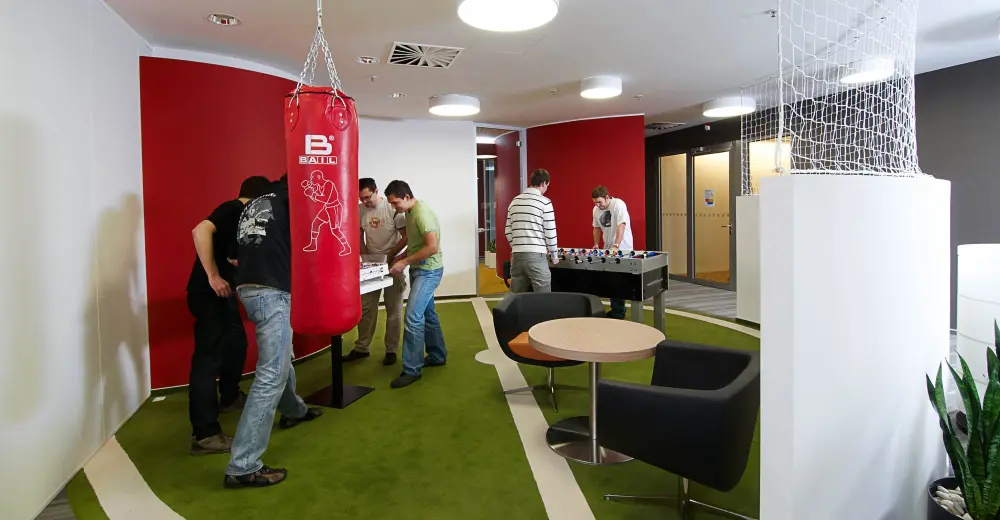
Do you remember AVG Brno, the “company with table football”? Where did it end up…
Happiness at work does not mean that every day is sunny and stress-free. It means a sense of purpose, fairness, and trust. It means knowing that what I do has value and that, as a person, I am not just a “resource” at work.
We often hear that success brings happiness. But practice and research show the opposite. People and teams who are successful in the long term are those who have a basic sense of satisfaction and security. First happiness, then success. Not the other way around.
This is a crucial message for Employer Branding. An employer brand is not created when a company is doing well. It is created much earlier. It is created by how people feel at work when things are not going well.
Work–Life Balance? No. Just Life
We often use the term work–life balance, but perhaps a little inaccurately. As if there were two separate worlds: work and life, between which we need to find a balance. But the reality is different. Life is one whole. It’s just that roles, priorities, and phases alternate within it.
Work-life balance is dead.
Carl Pullein on Work Life Balance vs Work Life Integration
Work is part of life. Just like family, friends, leisure, and personal development. The problem arises not when work takes up a lot of time, but when it starts to push everything else aside. Christmas often reminds us of this very clearly.
Companies that understand this do not think of work-life balance as a list of benefits. They think about sustainability. About whether people can function in the long term without burning out. And whether work fits into life instead of dominating it.
Sharpen the Saw: Why Rest Is not Weakness
In his book “The 7 Habits of Highly Effective People,” Stephen R. Covey talks about the important, often overlooked principle of sharpening the saw. The metaphor is simple: if you keep cutting but never sharpen, performance declines over time.
Sharpening the saw means renewal. Physical, mental, social, and internal. Rest, reflection, relationships, meaning. Not as a luxury, but as a necessity. Yet in many corporate cultures, rest is still perceived as weakness or a lack of commitment.
Management that ignores people’s regeneration is short-sighted. It may gain short-term performance, but in the long run it will leave exhausted teams and a damaged reputation. And no campaign can fix that.
Relationships and Trust as the Foundation of Happiness (and Brands)
When people look back on their lives, they rarely talk about projects or KPIs. They talk about relationships. And it’s no different at work. The quality of relationships with colleagues, managers, and the company as a whole has a fundamental impact on whether we feel good at work.
Trust, openness, respect. These are not soft concepts. They are the fundamental building blocks of happiness at work and, at the same time, the true essence of Employer Branding. What people experience within an organization, they carry with them outside. Into conversations with friends, on social media, in reviews, and even in job interviews.
An Employer Brand is not created through presentation. It is created through everyday interactions.
A Christmas Wish That Makes Sense
“Happiness, health, and peace.” We say it automatically, perhaps out of habit. But these simple words convey everything that matters. Wishing for well-being, peace, and health means wishing for an environment in which it is good to live and work.
Perhaps this is a good time for the company itself to make a similar wish. Not in the form of a slogan, but as a question: Are people really comfortable here? Does their work give them meaning? Do they have room to grow, relax, and be themselves?
Because building an Employer Brand doesn’t start with a campaign. It starts with answering these questions.
And Christmas is the perfect time to take an sincere look at them.

I enjoy connecting people who belong together, supporting their cooperation and inspiring them to find new solutions. I help companies create an attractive employer brand. I am interested in design thinking, lean approaches and agile marketing. You can also meet me as a lecturer at our workshops.