The end of the year is the ideal time to slow down. To stop and look at what has really happened around your employer brand. Not to praise or criticize yourself, but because without an honest understanding of the situation, without data, context, and insight, it is difficult to find vision and make plans for the coming year.
We expect 2026 to be particularly challenging for HR and EB teams, mainly due to faster changes in the talent market, pressure for efficiency, and much higher expectations for authenticity and quality of communication.
That’s why employer branding deserves the same attention at the end of the year as any other strategic process. If you examine three main areas—Customers (people), Company (your brand), and Competition (labor market)—you’ll get an idea of where you stand and what you need to do to make 2026 a stronger year.
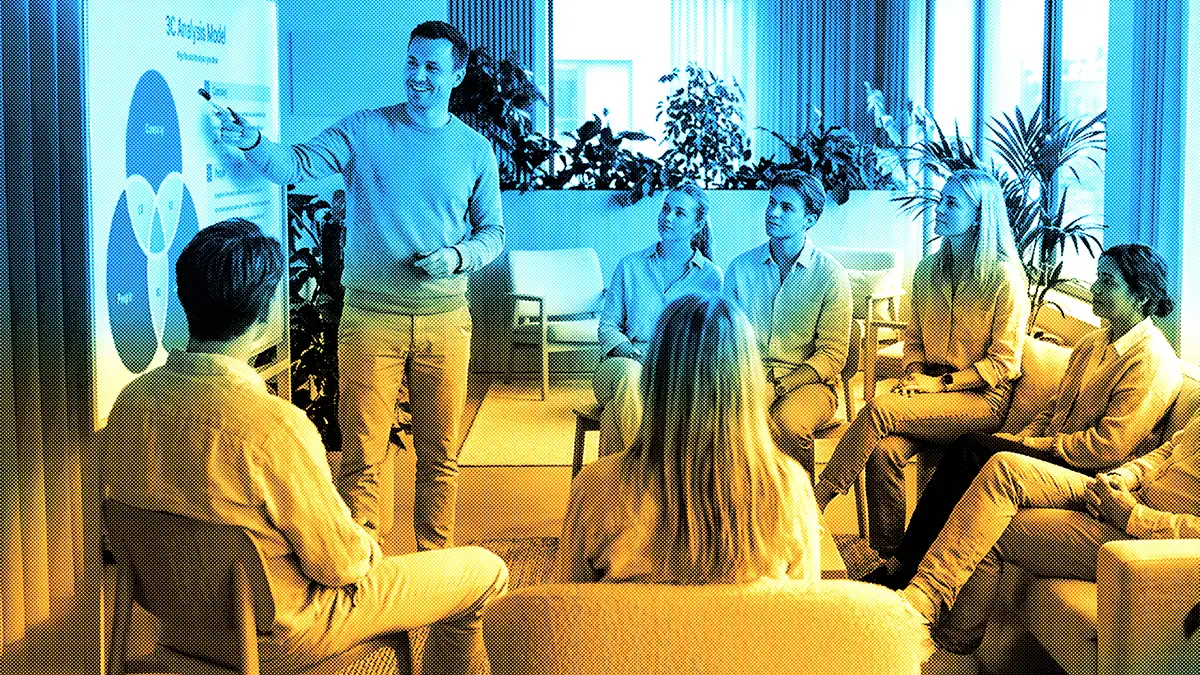
3C Analysis of the Employer Brand
If you want to start the new year truly prepared, it is worth going through the three basic areas that form the backbone of any quality retrospective — and are based on the proven 3C analysis framework (Customers, Company, Competition).
These three perspectives will help you see employer branding in its full breadth: from people and their experiences, to the actual form of your brand, to what is happening in the market around you.
- People — employees, applicants, the public
- The company as an employer — offer, brand, communication
- Competition and trends in the labor market
In this article, we describe a structure that is realistic, applicable, and can be mastered in a short period of time — even within a week.
Employees, Applicants, the Public
The most important thing to look at is not campaigns or numbers, but human experience. What kind of year did your employees have? What did candidates appreciate? And how does the public perceive you?
Offer, Brand, Communication
The second perspective is a look in the mirror: how have we performed as an employer this year? What do we really offer? What do we communicate? And how consistent and credible is that communication?
Competition and the Labor Market
Employer branding does not happen in isolation. Candidates compare offers across the market, trends change, and competition can sometimes surprise you.
1. 1. People: What Candidates and Employees Told Us This Year
Sometimes we feel that we know very well what candidates and employees think about us. However, real data often paint a different picture, at times more encouraging, at times less so.
In EB’s retrospective, the first step is therefore clear: look at people’s “work” and identify their real experiences, fulfilled expectations, and disappointments.
1.1 Candidate Experience: Where We Scored and Where We Lost Points
Start with a simple question: “What path did candidates take this year and where did they most often stuck?”
The data sources can be surprisingly simple:
- statistics from the career website and ATS,
- frequently asked questions and reasons for leaving during the recruitment process,
- comments, evaluations, references, and possibly even anonymous feedback from recruiters.
Look for three things:
- The moment when conversion dropped the most (e.g., between visiting the website and submitting an application).
- Recurring obstacles (length of the process, unclear communication, overly general ads).
- What candidates appreciated most (quick responses, a human approach, specific information).
This “trinity” will help you most in prioritizing in 2026.
1.2 Employee Voice: What Employees Are Concerned about and What Signals They Sent This Year
Your people are the most accurate indicator of the health of your employer brand. In retrospect, focus on:
- findings from pulse surveys and exit interviews,
- topics that came up in internal discussions,
- moments when the team appreciated your communication and moments when it fell short.
It is important to follow the trend, not individual complaints. If a topic has come up three times during the year in different forms, it is probably worth paying attention to.
1.3 Content & Engagement: What Resonated This Year
Check out all the main formats: articles, social posts, videos, newsletters. Look for:
- which posts had high engagement (and find out why),
- which formats have fallen out of favor and no longer work,
- what employees shared the most (authenticity tends to be the biggest winner).
From this data, choose the 3 biggest communication learnings.
2. Company: How Your Employer Brand Is Doing
An employer brand does not live in presentations or on digital boards. It lives in people’s experiences. And in retrospect, it’s the perfect time to find out where your EVP (Employee Value Proposition) met reality this year and where it fell short.
2.1 EVP in Practice: Where It Worked and Where It Faltered
Don’t look at your “value proposition” as “text on a website.” Try to see it as a set of specific commitments to your people. Ask yourself:
- Which parts of the EVP did we actually fulfill this year?
- Which promises did we fail to fulfill (and why)?
- Which elements of the EVP do candidates really miss/help them in their decision?
If you find that part of the EVP does not correspond to reality, it is not a problem, it is a valuable finding. At least once a year, the team should reflect on what has become outdated in the EVP.
2.2 Brand Communication: Consistency, Clarity, Appeal
Review the main communication channels: career website, social networks, recruitment campaigns. Focus on:
- consistent tone (do we always speak the same way?),
- clarity of the offer (is it clear why someone should come work for us?),
- user accessibility (usability, navigation, accessibility according to legislation).
In retrospect, it often becomes apparent that some parts of the website or campaign “take on a life of their own” because they have been changed ad hoc. This is the ideal place to identify areas that need updating in 2026.
2.3 Processes and Tools: What Slowed the Team Down During the Year
Sometimes the problem isn’t with the content or the EVP, but with the system. Try to answer the following questions:
- What did we spend too much time on this year?
- Which tools are no longer suitable for communication?
- What slowed us down the most in publishing or recruiting?
This part of the retrospective is often the most practical. It allows you to identify things that are not difficult to change but will save you hours of work next year.
3. Competition: What Happened on the Job Market This Year
Employer branding does not take place in a vacuum. Candidates perceive your offer in the context of the entire market. Therefore, in retrospect, it is worth looking at what was happening around you.
3.1 Recruitment Campaigns and Competitor Content
Select 3-5 main competitors and review their communications. Look for:
- innovations in campaigns or visuals,
- strong communication themes (e.g., wellbeing, home office, career growth),
- what had an obvious response from the audience (e.g., based on likes or comments).
You can make a simple table: what they do better, worse, and differently. It’s not just a benchmark, but also inspiration for your next steps.
3.2 Market Trends for 2025
Several trends worth noting have emerged this year:
- AI in recruitment and communication has become commonplace, but the difference lies in how it is used.
- Candidates are looking for authenticity, but also specific information: fewer slogans, more reality.
- Career websites are becoming a central point of decision-making, particularly due to changes in accessibility legislation.
Take a look at how much these trends have influenced your activities and results.
3.3 The battle for Talents
Try to answer the following questions:
- Did we have enough quality candidates this year, or did we go “all out”?
- Were we competitive compared to our surroundings?
- Which professions were harder to fill this year than before?
These answers will help you understand whether the problem is internal or market-related.
Three Main Conclusions from the Retrospective
Once you have all the data, it’s time to synthesize it. Without this, the retrospective will remain just a list of problems.
We recommend answering three clear questions:
1. What to Strengthen?
Choose one area that worked well this year and that makes sense to develop further next year. For example: authenticity in communication, career website, content marketing, working with employee stories.
2. What Should Be Reduced?
Choose one activity that has not been paying off in the long run and that takes up your time or energy. For example: campaigns with low impact, overly broad topics, formats that no longer work.
3. What Should You Start Doing Differently?
From the 3C analysis data, choose one new direction for the new year. For example: more systematic work with data, EVP redesign, consistent and distinctive communication.
Three conclusions are better than ten. It is much more likely that you will actually implement them.
How to Move from Retrospective to Strategy
Retrospective is only the first step. Only when you start translating your findings into adjustments, changes, and plans does the real work that has an impact begin.
In the next step (and in the next article), we will focus on, for example:
- adjusting EVP based on knowledge.
- refreshing the career website,
- cleaning up EB communication,
- recycling content,
- simplifying internal processes.
Here, knowledge becomes creation, and creation gradually becomes action.
Conclusion: Take an Hour and Write Down the Three Biggest Findings of 2025
An EB retrospective doesn’t have to be a big workshop or a two-day analysis. If you take only one thing away from this article, let it be this:
Shake off the whole year, look at the facts, and write down your three most important conclusions. They will serve as your compass for 2026.

I have been working with MenSeek for over 10 years. During that time, I have had the opportunity to participate in many diverse projects for various clients: from building websites to online campaigns and creating magazines to complete employer branding. In our team, I mainly take care of texts. My dream is to travel the world and I always try to fulfill my dreams. I also enjoy sports and tourism, I like reading and, as a true Czech, I like beer.